I am writing these sentences just ten minutes or so before the commencement of the 2012 Summer Olympics Opening Ceremonies. This is the second event the Addison Recorder has deemed worthy of keeping a running diary during. Like the first, it has a lot to do with sports…indeed, the Olympics are in my mind the epitome of sports, the greatest athletes in the world competing for national pride and the chance to break some records. But the Opening Ceremonies in particular are a mixture of athleticism and culture, a chance for the host nation to revel in their heritage and promote it for the world.
And after that high-minded introduction, inspired by my own lifelong love of the Olympics, so much that I’ve read reference books about the games cover to cover, I will promise to be irreverent and biting about the Ceremonies.
England has not hosted the Olympics since 1948, when Clement Attlee was pulling the U.K. out of its wartime haze. Now, in 2012, London is arguably the soundest world financial capital, England’s moving along pretty darn well compared to us, and their aesthetic standards since the war guarantees an event like no other. Oscar-winner Danny Boyle has put together the show. Knowing and loving Boyle’s films…this could go many ways. What if he draws some ideas from his own work? Giant, flashy, A.R. Rahman-style dance numbers and whimsical interactions between children and supernatural figures? I’m game! Heroin-addled hallucinations and men cutting off their own arms? Not so much. Zombies? Maybe.
Welcome to “Recorded Conversations,” an occasional feature where all the Addison Recorder editors contribute their thoughts about a question, idea, or prompt. Everyone will chime in, and then we see where the conversation wanders. After the annual pop culture festival that is San Diego Comic Con, and shortly before fall semester starts at universities, J. Michael Bestul has posed this quandary:
Question: You’re teaching a class in popular culture, literature, or the like. As part of your curriculum, you need to incorporate one graphic novel or comic book series, and only one. Which one do you use, and why?
—
I have to admit that I am not nearly so versed in graphic novels and comics as J. and Andrew. Certainly, I enjoy them, but I have never made it a point to explore them in full. Thankfully, I actually do teach courses where I would encounter just such an predicament as J. laid out in his prompt, so I have an answer all ready to go.
My choice if I were to teach one graphic novel in a course would be Ghost World by Daniel Clowes. It’s the story of two disaffected teenage girls, Enid and Rebecca, drifting through their post-graduation life with an excess of ennui and a distinct lack of direction. As written and drawn by Clowes it’s the type of works that feels at once deeply personal and surprisingly universal. Certainly, not every student is going to see a direct reflection of their dyspeptic suburban environment, as I did when I first read it. But the feelings of discontent that both girls feel are undoubtedly universal, especially at that stage of late adolescence.
Neither Enid nor Rebecca have big dreams in Ghost World, just a desire to find something meaningful to do, and maybe someone to care about without a protective layer of irony. Not exactly the Jay Gatsby-types, but Ghost World is a much more grounded work than Fitzgerald could have dreamed of. Ghost World isn’t set in the here and now anymore (it was published almost 20 years ago, ye gods…), but it depicts universal emotions in such a specific manner that I think it would resonate strongly despite any initial skepticism towards the form or its content.
That reluctance plays into my decision as well. In my teaching experience, it has been a repeated delight to push new materials on my students when they expect not to like it. Screening films like The Tree of Life, Gegen die wand, or even Young Mr. Lincoln is met with groans and eye-rolls. Most 19-year-olds aren’t terribly interested in pushing their own cultural boundaries, and don’t expect to ever like anything they encounter in a classroom. Introducing a graphic novel that is not about superheroes, and which doesn’t make up for that with romance or drama, seems like a sure way to engender grumbling.
So when it comes time for class discussion, it is deeply gratifying to hear “I expected to hate it, but that was really interesting.” Not every reaction will be like that, obviously, but I fully expect that Ghost World would earn the remark from someone. Other graphic novels would do much the same, of course. But Ghost World means a lot to me, and half the fun of designing your own curriculum is making others experience things you enjoy, so it wins.
—
Read the responses from the other editors,J., Andrew, and Travis, as they are published throughout today
Welcome to “Recorded Conversations,” an occasional feature where all the Addison Recorder editors contribute their thoughts about a question, idea, or prompt. Everyone will chime in, and then we see where the conversation wanders. After the annual pop culture festival that is San Diego Comic Con, and shortly before fall semester starts at universities, J. Michael Bestul has posed this quandary:
Question: You’re teaching a class in popular culture, literature, or the like. As part of your curriculum, you need to incorporate one graphic novel or comic book series, and only one. Which one do you use, and why?
—
Answering this question was rather easy. There are four graphic novels which have surpassed the level of merely “inspirational” for me, and then it became a process-of-elimination game.
Jeff Smith’s Bone, which I have written about before, is at 1,332 pages—and every one of them densely packed—too long for this purpose. As much as I love Fun Home, Alison Bechdel’s work increasingly tips the balance in favor of words over pictures when they should be ideally equal. And Craig Thompson’s Blankets, even though it is the only comic which has ever made me weep, got crossed off for an odd reason. Even though Thompson’s illustrations are of the highest aesthetic caliber, I realized that except in a few places (the breathtaking, I’m trembling just thinking about it image of Craig and Raina’s bodies fused together, for example), the pictures and design augment the impact the reader feels as opposed to being in a symbiotic relationship with the story to create that impact.
(The same goes for Ray Fawkes’s breathtaking One Soul, which I recently finished and highly recommend.)
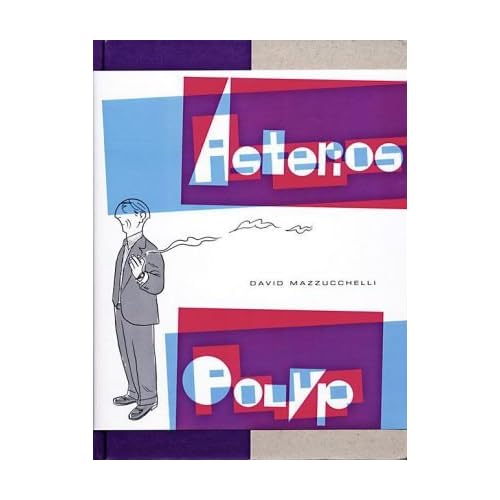
In comparison to these books, Asterios Polyp by David Mazzucchellirevels in displaying all that the graphic novel is capable of, when not going farther and actually pushing the boundaries.
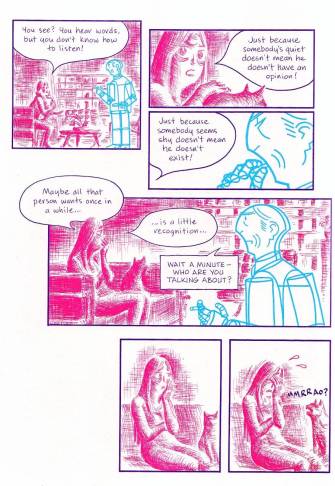
Every few pages, and sometimes in the same panel, Mazzucchelli will alter the paneling method, the color scheme, even the types of lines he is using to draw, creating a work which is as much a master class on how much variety lies in comics aesthetic and practice as Scott McCloud’s non-fiction titles. (Even Thompson sticks to the traditional one-panel-after-another form.) More importantly, Mazzucchelli is not showing off with this array of choices: every time his drawing and layout undergo a stylistic shift, it accompanies a change of scene and tone in the story; to take only one example, when Asterios and Hana have an argument, curvy florid red lines fill half a very detailed panel and blur into sharp geometric blue lines, reflecting the emotional distance between them. His words and pictures complement each other in a way very few texts in the medium have ever achieved.
But Asterios Polyp is more than a technical marvel. Mazzucchelli also tells a profound and gripping story laden with philosophical and romantic themes, and tells it with all the skill of a great novelist. He ties together multiple plotlines and uses recurring details in ways which make one want to immediately start the book over once finished. Best of all, the storytelling feels impossible without the illustrations. I cannot spoil anything, and do not even wish to talk about the plot to any extent. I will say that on the very first pages, a scene occurs which grows more and more laden with meaning as the reader discovers the many facets of Asterios. The scene’s significance could have been described with words alone, but I doubt this possibility…and even if it could have, it would have been far more difficult and hard to convey without Mazzucchelli’s well-chosen, ultimately heartbreaking imagery.
Asterios Polyp combines superb storytelling and pictorial artistry of the most innovative sort, and does so in a way which displays how words and pictures can work together in the best ways and not merely sit side by side. If I had to teach one graphic novel, pick only one which could encapsulate all that is wonderful and possible with the medium, it would be Asterios Polyp.
—
Read the responses from the other editors,J., Bean, and Travis, as they are published throughout today
Welcome to “Recorded Conversations,” an occasional feature where all the Addison Recorder editors contribute their thoughts about a question, idea, or prompt. Everyone will chime in, and then we see where the conversation wanders. After the annual pop culture festival that is San Diego Comic Con, and shortly before fall semester starts at universities, J. Michael Bestul has posed this quandary:
Question: You’re teaching a class in popular culture, literature, or the like. As part of your curriculum, you need to incorporate one graphic novel or comic book series, and only one. Which one do you use, and why?
—
I came up with the “one and only one” limit to make this challenging for myself, and to the other sequential art geeks that may inhabit the Recorder’seditorial board. As someone who’s taken a university course that focused on nothing but comic books in culture, and presented a conference paper on them – and whose wife works at a comic book shop – the challenge is in the limitation.
So let’s start with what kind of hypothetical class I’d be teaching. Since I get the unrealistic ability to choose my class in this scenario, it would likely involve American fiction, speculative or supernatural fiction, or mythology in modern — and Modern (and Postmodern) — storytelling. The comic book in question would need to:
tie back to other class readings, and
illuminate other facets of popular culture in its own unique manner.
With that in mind, my series of choice would be Mike Mignola’s Hellboy. I’d prefer to utilize the entire Mignola-verse (Hellboy, BPRD, etc.), but if I could only use one book, it would likely be Hellboy: the Conqueror Worm.
Since there would be a heavy focus (in this hypothetical class I’m teaching) on genre fiction (Bierce, Lovecraft, Howard, Borges, García Márquez, Asimov, Pratchett, Gaiman, Hill), and the theoretical underpinnings of mythmaking & intertextuality (Campbell, Jung, Eco), I would want a superhero comic book that could easily connect with these foci.
Tying the Mignola-verse together with these other readings is the easy part. Hellboy is a variation on our old friend, the heroic monomyth, but it also is a study in intertextuality. Mignola is very open about where he derives his stories from – whether he is retelling a piece of Asian or Celtic folklore, or utilizing the cosmic monsters (and their amphibian/human hybrid minions) that are a direct reference to Lovecraft’s Mythos.
But more than intertextuality, there are other pop culture connections that can be taught via Hellboy. One is the difference in storytelling between media (say, the Hellboy / BPRD books, graphic novels, and films – as well as Geek & Sundry’s “Motion Comics”), and another is the conventions of the comic book medium itself. As fellow Addisonian Alex pointed out in our last Conversation, sitcoms always tend to wrap up by the end of the episode. That is, they are episodic – after the conflict is resolved (or pushed back), the fictional world returns to its neutral state in time for the next episode.
Superhero comics are very, very similar. Even if a series-changing event occurs (e.g., death of a main character), at some point the series will only bend so far before that event must be undone or unwound (e.g., character comes back to life, or was not dead) — thus snapping the series back to its neutral state.
The Mignola-verse series defy that convention. The author has acknowledged this defiance in a recent story arc, indicating that in these series, when something is broken, it stays broken. The first dramatic example of this was with Hellboy: the Conqueror Worm, wherein Hellboy is pushed into a situation that goes against his character. When the tale ends, this causes him to reject the neutral state, thereby moving the narrative beyond episodic conventions.
And in the years since, Hellboy has only further broken from the episodic “return to neutral.” In the latest tales, for example, Ragnarok actually happens. Populations are wiped out. The world doesn’t go back to the old normal:
That’s what Professor Bestul is offering up this semester. How about the rest of you gents?
—
Read the responses from the other editors,Andrew, Bean, and Travis, as they are published throughout today.
I’ve been wracking my brains for a few weeks on how to present this.
‘This’ being a discussion or analysis of tabletop games, a topic that, once upon a time, didn’t require the adjective in front of ‘games.’ But with the advent of video games, and the blurring of lines between sports and gaming (whether referring to betting, fantasy sports, or poker & darts on ESPN), I’ve felt that the grand tradition of tabletop games has become the long-lost brother of Western pop culture and entertainment.
And this led me to an idea: if we can break down & analyze movies, books, and music, why not do the same with games? Sure, I can go to Boardgamegeek.com and find such writing, but why can’t we also bring it to a more general audience? Hence the experiment that is my new series for the Recorder, “Games on Addison.”
The goal of this series is to explore and analyze tabletop games in the same manner as other forms of popular entertainment — film, music, video games, books, and the like. It is not meant to be a ‘review’ of these games, but a means of bringing attention to and discussion of games in a popular culture forum (that is, the Recorder).
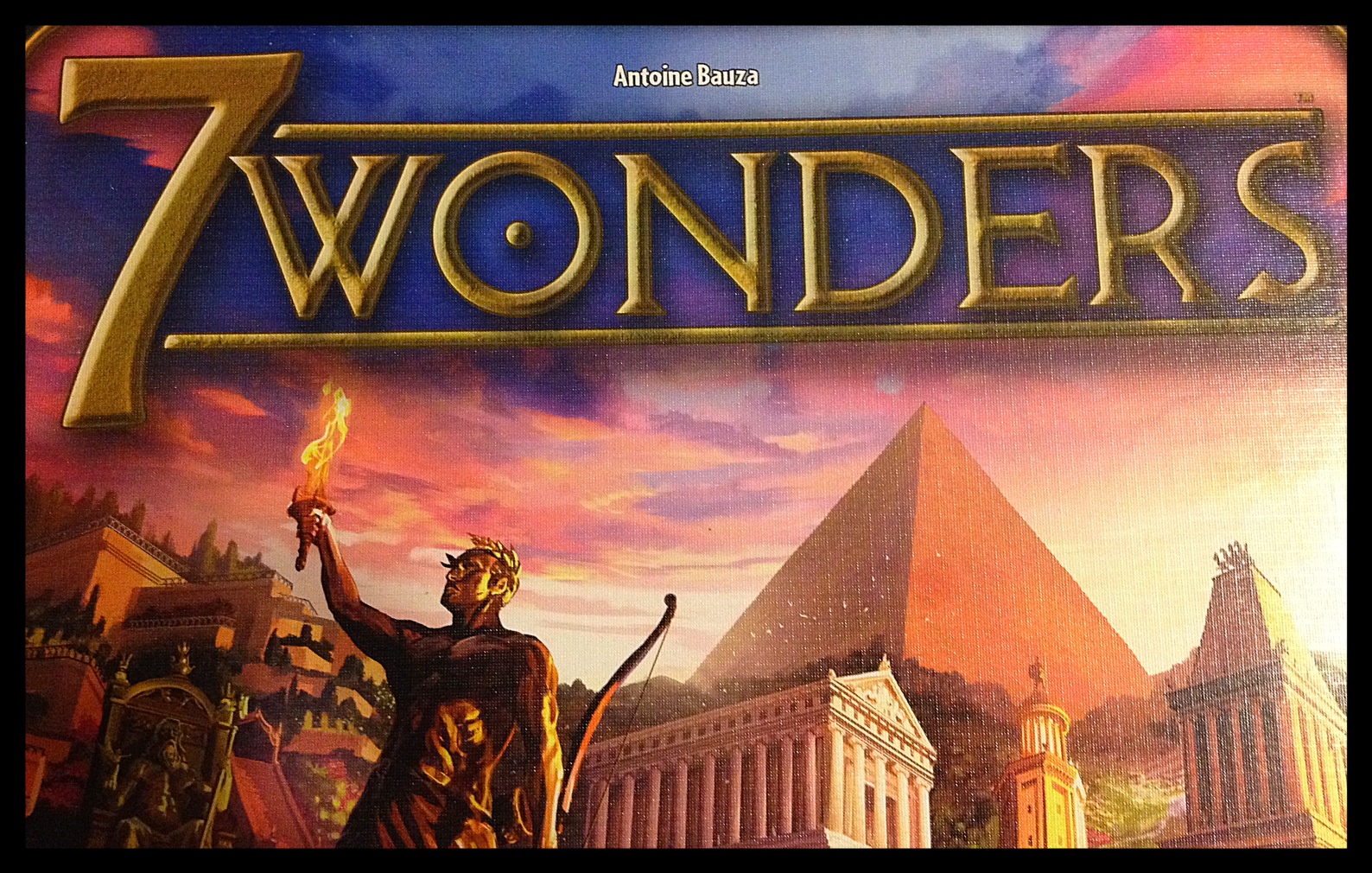
This idea has been percolating in my brain for years, though the advent of the Geek & Sundry web channel (and its gaming series, Tabletop) brought it back to the forefront. Thus, for the first entry in this series, I’ll hearken back to a game I briefly mentioned when I wrote about Tabletop and digital media: 7 Wonders.
Check out all that Wonder.
7 Wonders is a recent and award-winning game from Repos Productions, wherein each player is takes the role of one the civilizations that built the Seven Wonders of the Ancient World (hence the name). It’s a game that rewards resource management and adaptability, and once the players get the hang of the mechanics, it plays exceedingly quick.
To begin, let me just say that, on behalf of all of us at the Addison Recorder, I would like to offer our condolences to all of the victims of the shooting that happened early this morning at the movie theatre in Aurora, CO. These murders are horrifying, a senseless act of violence that might seem like a vast impossibility, and because of the nature of this particular act, many of us around the nation, and the world, are in a deep state of mourning today.
There are many things to be said about this attack. I want to try and keep from politicizing the nature of the event, casting blame about, and making this into something more than it is. Lord knows that I want to rant about several things, and I’ve struggled with this in my mind as I sit down to write out my thoughts and feelings. Therefore, I apologize if this gets wordy, windy, or overly dramatic. If you wish to avoid such thoughts (though I’m trying to avoid getting preachy), close out now and you won’t have to suffer through my thoughts.
“Before sunrise she was off the plain and she would raise her muzzle where she stood on some low promontory or rock overlooking the valley and howl and howl again into that terrible silence.” – Cormac McCarthy, The Crossing
How does one deal with eternity?
Time’s irresistible march forward is the defining aspect of the universe as we know it, a constant that outlasts all other constants. Even without understanding the exactitudes of the time-space continuum, humans have known it since our very beginnings. Time was relentless and punishing, offering no chances for our ancestors to go back and correct their mistakes. Looking at structures from pre-historic peoples all across the globe we see monuments to the seasons and the stars. These were aspects of the eternal that humanity could understand and put into order. Dawn struck at precisely the same spot at Stonehenge each solstice, and so a temple was built there and rituals were performed because those ancients understood just a sliver more of the universe’s mysteries.
Each religion and every civilization has endeavored to accumulate or illuminate more and larger such slivers, because understanding more might eventually lead us to understanding it all. As more knowledge is accumulated and recorded human existence gets easier and we progress towards greater knowledge and organization. Farmers learn the rhythms of the seasons, fishermen come to understand the tides, and life is that much less a hardscrabble struggle for survival. Eternity seems less daunting as we master more and more, even if the individual people within each society will never know what lies beyond our their inevitable doom. Knowledge gets passed along, and life gets better, but it still ends. The void still looms, even for the denizens of the richest and most advanced nations. One of the most common efforts to deal with that gnawing uncertainty is to mark death. Memorializing someone’s expired form with a headstone, remembering the past we knew with them, and making an effort to live better in their honor, is perhaps our only way to indicate anything to the void.
Tommy Lee Jones’ directorial debut The Three Burials of Melquiades Estrada is about just such an effort. Set in the borderlands along the Rio Grande, its tells a story about death and redemption that resonates with the mythic power of the best Westerns. Jones plays the lead role, a rancher named Pete Perkins, whose friend, the titular Melquiades Estrada (Julio Cedillo), is found partially buried in the wilderness in the film’s opening moments. All signs seem to point towards new Border Patrolman Mike Norton (Barry Pepper), a cruel hothead recently relocated to West Texas from the Midwest, being behind the apparent murder. Not wanting to stir up trouble with the powerful Border Patrol over an illegal immigrant’s anonymous demise, the local sheriff (Dwight Yoakam) refuses to press the case any further than he has to and quickly reburies Estrada in an undistinguished lot. Perkins responds to this miscarriage of justice by kidnapping Norton, forcing him to dig up Estrada’s body, and lashing both men to some horses in order to bring Estrada’s body back to his homeland across the river.
I. “Hey, man, I’m selling my guitar so I can play the electric jug.”
Thinking about the early Bee Gees records reminded me that they were far from the only musicians to decide in 1967 that it was time to step up their ambitions. On both sides of the Atlantic, new and established acts alike could not help but hear the innovation happening around them. It was more than Sgt. Pepper and Revolver: the painstaking beauty of the Beach Boy’s Pet Sounds, the increasingly elaborate and emotional wordplay of Bob Dylan’s electric albums, and the fearless, avant-garde experimentation of Frank Zappa and the Mothers of Invention on Freak Out! all helped to expand the definition of what pop and rock were capable of. And in 1967, there were no nationally-televised prime-time singing competitions, no radio conglomerates; was marketing, but marketing was new and willing to take chances. An artist could push the boundaries and get major-label deals and mainstream exposure.
The results were some terrific albums like those of the Brothers Gibb…and a lot of mediocre and just plain bad material. There’s only so many “electronic masses” and sound collages and electric jug bands a person can absorb without going insane.
Yes, complete with an ELECTRIC FREAKIN’ JUG! See what the guy on the far left is holding? Do you SEE THAT? Who thought this was a good idea?!
Two memories from my childhood came to mind when I heard that Robin Gibb had died in May.
First, my parents’ laughter as “Stayin’ Alive” or “How Deep Is Your Love” came on the car radio and a four or five year old Andrew proudly declared that this was the BeeGees with a very hard G. I was conscious of the Bee Gees even that young. Say what you like about them, there was a stretch of several years when Barry, Maurice, and Robin Gibb, and their solo brother Andy as well, were inescapable in every part of the globe, and that gave them a permanent, ubiquitous place in pop culture, veering on the scale from the mostly ridiculed to the mostly respected. That ubiquity makes it harder to believe that the Bee Gees are now truly no more, as only Barry remains with us from the Brothers Gibb.
A few weeks ago on Facebook, my old friend Jonathan Callan (a fantastic writer in Los Angeles) responded to a comment of mine with the words, “Andrew: I love you but you’re lame. Get a role model with an actual skill.”
The “role model” whose praises I had been singing in my own comment is Chris Hardwick, the comedian who made the unexpected transition from being a punchline himself, as the host of the successful but reviled MTV show Singled Out, to the mastermind behind the acclaimed Nerdist Podcast and the accompanying Nerdist Industries website.
Hardwick and his to-do list.
Naturally, as a fan of Hardwick’s I took offense to this remark, but the writer in me wanted to produce a more thoughtful reply beyond “he does so have actual skills!” Thus, I got to thinking, and the answer came during a listen to one of my favorite episodes of the Nerdist Podcast (#204, “Gersberms”). It suddenly struck me how much Hardwick resembled one of his own heroes, and this resemblance made me further realize what precisely Hardwick’s greatest talent is.
I would argue that Chris Hardwick is the 21st Century equivalent of Johnny Carson.